
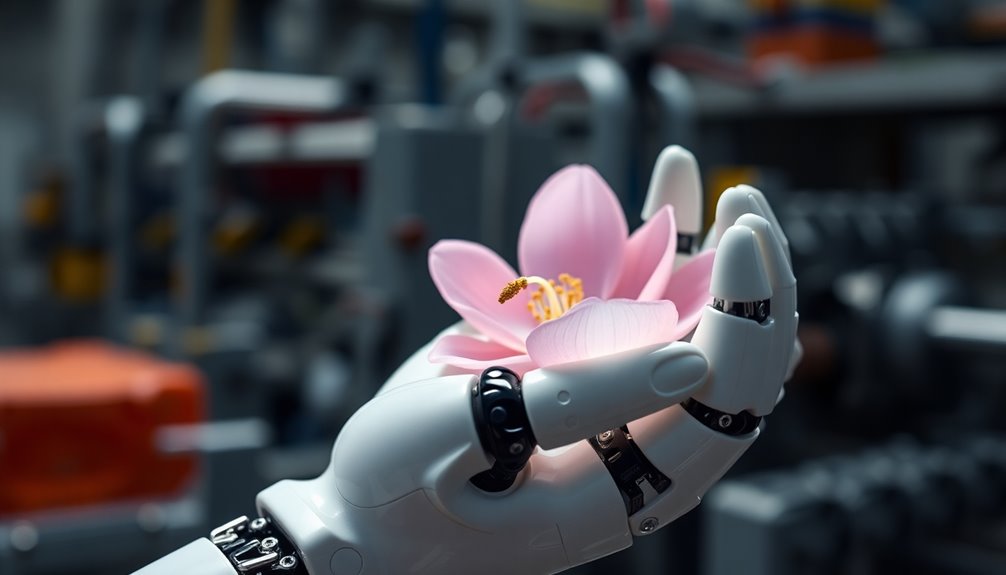
Soft robotics is essential for advancing automation because of its ability to improve flexibility, adaptability, and safety across various industries. By utilizing materials that mimic natural movements, these technologies can handle delicate tasks without damage. They're likewise making strides in healthcare, manufacturing, and agriculture, increasing efficiency and reducing labor demands. With continued advancements, soft robotics is set to redefine operational possibilities, ensuring a harmonious blend of innovation and human capability in the future. More insights await.
Article Highlights
- Soft robotics enhances flexibility and adaptability, allowing automation to navigate complex environments and handle delicate tasks more effectively.
- Bio-inspired designs in soft robotics improve efficiency and functionality, leading to innovative solutions in automation across various industries.
- Lightweight and robust structures in soft robotics reduce energy consumption, making automated processes more cost-effective and sustainable.
- Adaptive grippers and customizable components enable soft robots to perform a wide range of tasks, enhancing versatility in automation.
- The integration of soft robotics in automation promotes improved safety, reducing injury risks for workers while boosting productivity.
Understanding Soft Robotics: An Overview
Soft robotics represents a fascinating intersection of engineering and biology, where flexibility and adaptability take center stage. These innovative systems leverage soft robotics fundamentals, emphasizing the use of materials that can bend, stretch, and compress without losing functionality. Unlike traditional rigid robots, soft robots utilize material flexibility to navigate complex environments, allowing them to perform tasks that require delicate handling. This adaptability makes them particularly appealing for applications in fields like medicine and exploration, where traditional machines might struggle. By mimicking natural movements, soft robotics opens new avenues for creativity and innovation. As they evolve, these technologies promise to improve human experiences, offering a sense of freedom in automation that traditional systems can't match. The future looks bright for soft robotics.
The Advantages of Soft Robotics in Automation
As industries increasingly embrace automation, the unique advantages of soft robotics become evident. Soft manipulation allows these robots to handle delicate materials without damage, making them ideal for diverse applications. Adaptive grippers improve versatility, adapting to various shapes and sizes with ease. Bio-inspired designs draw from nature, ensuring efficient movement and functionality. Material innovation plays a vital role in creating lightweight yet robust structures, leading to improved energy efficiency. Moreover, soft robotics enable agile locomotion, allowing them to navigate complex environments effortlessly. User-friendly interfaces simplify operation, making automation accessible to all. Finally, soft robotics present cost-effective solutions, reducing the need for expensive machinery while increasing productivity, ultimately freeing industries to innovate further and improve their operational capabilities.
Applications in Healthcare: A New Frontier
Soft robotics is transforming healthcare by introducing innovative solutions like surgical assistance robots and rehabilitation tools. These technologies elevate precision during surgeries and provide personalized therapy options for patients. As these advancements continue to evolve, they promise to improve patient outcomes and redefine the standards of care.
Surgical Assistance Robots
As advancements in technology continue to transform various sectors, surgical assistance robots represent a groundbreaking shift in healthcare. These innovative machines improve surgical precision, enabling doctors to perform complex procedures with unprecedented accuracy. By utilizing robotic dexterity, they can navigate tight spaces and manipulate tissues in ways that human hands cannot. This not only minimizes invasiveness but additionally reduces recovery times, giving patients more freedom to heal and return to their lives. Furthermore, surgical assistance robots empower surgeons, allowing them to focus on strategic decision-making rather than being bogged down by physical limitations. As these technologies evolve, they promise to redefine surgical practices, ultimately leading to safer outcomes and improved patient care in an increasingly automated world. Additionally, the integration of biotechnology and AI in surgical robotics can further enhance precision and efficiency in complex procedures.
Rehabilitation and Therapy Tools
Rehabilitation and therapy tools are revolutionizing patient recovery in healthcare, offering innovative solutions that improve mobility and independence. These soft robotic devices are transforming rehabilitation strategies, making therapy more accessible and effective. Patients can now experience enhanced support and engagement during their recovery paths, encouraging a sense of freedom and empowerment.
- Adaptive exoskeletons that assist with movement
- Interactive robotic arms for improved fine motor skills
- Wearable sensors tracking progress and providing feedback
- Virtual reality systems for immersive therapy experiences
These therapy innovations not only promote physical recovery but additionally boost mental well-being, enabling individuals to regain control over their lives. As technology advances, the potential for soft robotics in rehabilitation continues to expand, paving the way for a healthier future.
Enhancing Manufacturing Processes With Soft Robotics
Soft robotics is revolutionizing manufacturing by introducing flexible materials that adapt to various tasks. This adaptability not merely boosts efficiency but additionally greatly improves safety standards in industrial environments. As these innovations continue to evolve, manufacturers are finding new ways to optimize processes and reduce risks.
Flexible Material Applications
Even though traditional manufacturing often relies on rigid materials that can limit flexibility and adaptability, the integration of soft robotics into production processes is revolutionizing the way industries operate. By utilizing bio-inspired materials and adaptive structures, manufacturers can achieve unprecedented levels of efficiency and versatility.
- Improved product handling with delicate materials
- Customizable robotic components for various tasks
- Greater energy efficiency through lightweight designs
- Enhanced adaptability for diverse production environments
Soft robotics allows for a more fluid approach to manufacturing, enabling companies to pivot and innovate with ease. As these technologies advance, the potential for creative applications expands, giving industries the freedom to explore new possibilities and redefine their operational environments. Additionally, the incorporation of advanced navigation systems can further enhance the capabilities of soft robots in dynamic manufacturing settings.
Improved Safety Standards
The integration of soft robotics not only increases flexibility in manufacturing but likewise greatly improves safety standards across various industries. These safety innovations promote a workplace where employees can thrive without fear of injury. Unlike traditional rigid robots, soft robots can adapt to their environment, reducing the risk of accidents and improving overall workplace safety.
| Benefits | Traditional Robots | Soft Robotics |
|---|---|---|
| Injury Risk | High | Low |
| Employee Trust | Limited | Improved |
| Adaptability | Rigid | Flexible |
Soft Robotics in Agriculture: Transforming Food Production
As agriculture faces increasing challenges from climate change and labor shortages, soft robotics is emerging as a transformative solution in food production. These innovative technologies improve precision farming and crop monitoring, allowing farmers to operate more efficiently and sustainably.
- Soft robots can gently harvest delicate fruits without damage.
- They provide real-time data for precise crop monitoring.
- These systems adapt to various terrains, enhancing field access.
- They reduce reliance on manual labor, addressing workforce shortages.
- By leveraging digital solutions like e-health, soft robotics can further enhance the overall efficiency and sustainability of agricultural practices.
The Role of Soft Robotics in Search and Rescue Operations
As traditional search and rescue methods often face limitations in challenging environments, soft robotics is revolutionizing this field by offering flexible, adaptive solutions. These innovations improve disaster response capabilities, allowing responders to navigate debris and confined spaces with ease. Unlike rigid robots, soft robots can conform to various shapes and surfaces, maximizing their effectiveness in unpredictable terrains. Their robotic flexibility enables them to gently interact with victims, minimizing further harm during the provision of vital assistance. Additionally, soft robots can access areas that are simply unreachable for conventional machines, broadening the reach of rescue efforts. By integrating soft robotics into search and rescue operations, teams can utilize new levels of efficiency, adaptability, and in the end, save more lives in critical situations. This integration aligns with the need for continuous skill updates necessary for competitiveness in the knowledge economy.
Addressing Safety Concerns With Soft Robotics
Safety remains a paramount concern in the development and deployment of soft robotics. Addressing these concerns is vital for nurturing effective human-robot collaboration. By implementing rigorous risk assessments, developers can guarantee these systems are safe for various applications.
- Soft robotics reduce the risk of injury owing to their compliant materials.
- Adaptive designs allow robots to navigate complex environments safely.
- Continuous monitoring systems improve real-time safety responses.
- Transparent communication between robots and humans promotes trust.
Ultimately, by prioritizing safety, the industry can reveal the full potential of soft robotics, empowering a future where automation complements human capabilities rather than replacing them. This balance is significant for embracing a world where freedom and innovation coexist harmoniously.
Challenges and Limitations of Soft Robotics
Though soft robotics holds great promise, it also faces several challenges and limitations that hinder its widespread adoption. Material durability remains a concern, as many soft materials can wear down over time. Control algorithms need further refinement to improve the precision and responsiveness of soft robotic systems. Scalability issues arise when trying to produce these robots in larger quantities without greatly increasing manufacturing costs. Integration challenges with existing technologies complicate their deployment. Performance limitations, owing to design complexity and varying environmental adaptability, restrict their versatility. Furthermore, inadequate sensing capabilities can impede functionality. Finally, regulatory hurdles often delay development and market entry, making it crucial to address these issues to reveal the true potential of soft robotics in automation.
The Future of Automation: Integrating Soft Robotics Into Industries
With the rapid advancements in technology, integrating soft robotics into various industries promises to transform automation. This shift aligns with current soft robotics trends, which focus on improving flexibility and adaptability in work environments. As industries embrace this innovation, they can expect several benefits:
- Improved safety and reduced injury risks for workers
- Increased efficiency in manufacturing and logistics processes
- Greater flexibility in handling delicate items or tasks
- Accelerated development and deployment of automated solutions
The potential for industry integration is immense, allowing sectors like healthcare, agriculture, and manufacturing to leverage soft robotics for customized solutions. Additionally, integrating soft robotics with smart traffic management systems can optimize logistics and supply chain processes. By embracing these advancements, industries can promote a future where automation improves human capabilities rather than replacing them.
Frequently Asked Questions
How Do Soft Robots Differ From Traditional Robots?
Soft robots differ from traditional robots primarily in their design and functionality. Soft robot design emphasizes flexibility and adaptability, allowing them to navigate diverse environments. Unlike rigid robots, they often utilize flexible actuators, which enable smooth movements and safer interactions with objects and humans. This adaptability opens up possibilities for applications in delicate tasks where traditional robots might struggle, making soft robotics an engaging field for those seeking innovation and freedom in automation.
What Materials Are Commonly Used in Soft Robotics?
When exploring materials used in soft robotics, one finds that silicone elastomers are a popular choice because of their flexibility and durability. These materials allow for the creation of structures that can mimic natural movements. Moreover, pneumatic actuators play an essential role, enabling soft robots to achieve fluid motion through air pressure. Together, these components offer the freedom to design robots that can navigate complex environments and interact safely with their surroundings.
Can Soft Robotics Be Used for Underwater Applications?
Soft robotics certainly shines in underwater applications. With its flexibility and adaptability, it's ideal for underwater exploration and marine engineering. These innovative machines can maneuver through complex aquatic environments, reaching places traditional robots can't. They're gentle enough to interact with delicate marine life, promoting preservation as they perform tasks. As they navigate the depths, these soft robots offer the freedom to explore and understand underwater ecosystems like never before, enhancing our connection to the ocean.
How Does Soft Robotics Impact Energy Consumption?
Soft robotics greatly impacts energy consumption by promoting energy efficiency through its design. Unlike traditional rigid robots, soft robots often require less energy because of their lightweight and flexible materials. This sustainable design not merely reduces operational costs but additionally minimizes environmental footprints. By adopting soft robotics, industries can embrace innovative solutions that empower their operations as they align with a commitment to freedom and sustainability, making them more adaptable to changing needs and conditions.
Are There Ethical Concerns Surrounding Soft Robotics Development?
In a world where robots might soon outsmart their creators, one can't help but chuckle at the thought of soft robotics becoming our overlords. Yet, with such advancements come ethical implications that can't be ignored. The societal impact of these technologies raises questions about autonomy, job displacement, and surveillance. Should humanity welcome our squishy new friends, or are we inviting a plushy Pandora's box that could redefine what it means to be free?