
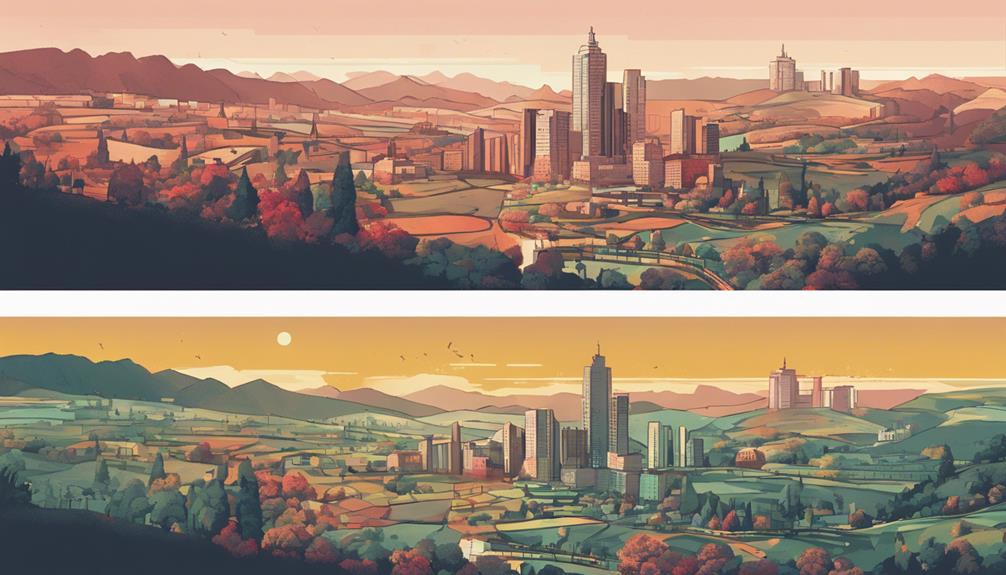
The rural-urban divide is a pervasive and multifaceted phenomenon characterized by significant economic, social, and cultural disparities between metropolitan centers and rural areas. Metropolitan areas boast higher average incomes, better access to financial services, and more lucrative job opportunities, while rural regions struggle with poverty and limited economic infrastructure. Rural areas also face shortages of medical professionals, limited healthcare facilities, and inadequate educational resources. Moreover, skilled workers are drawn to urban job opportunities, leading to a rural brain drain. To tackle these disparities, a nuanced understanding of the complex dynamics is essential, and exploring the underlying causes can reveal paths to a more equitable future.
Economic Disparities Between Rural and Urban
Across the globe, a stark economic dichotomy exists between rural and urban areas, where metropolitan centers often boast higher average incomes, greater access to financial services, and more lucrative job opportunities, while rural regions struggle with poverty, limited economic infrastructure, and a dearth of employment options. This disparity has far-reaching consequences, perpetuating income inequality and limiting social mobility for rural residents. The scarcity of job opportunities in rural areas forces many to migrate to urban centers, leading to a brain drain and further exacerbating the economic divide.
The unequal distribution of wealth and access to social services also contribute to the economic chasm between rural and urban areas. Urban centers typically have better-developed social services, including more extensive public transportation, superior healthcare facilities, and a wider range of community programs. In contrast, rural areas often have limited or non-existent social services, leaving residents to fend for themselves. This uneven playing field hinders rural economic development, making it challenging for individuals to break the cycle of poverty.
Bridging the economic gap between rural and urban areas requires a concerted effort to address these disparities. Investing in rural infrastructure, expanding access to financial services, and creating job opportunities can help stimulate economic growth and reduce income inequality. By recognizing the underlying causes of this dichotomy, policymakers can work towards a more equitable wealth distribution, ultimately narrowing the economic divide between rural and urban areas.
Access to Healthcare and Education
Beyond the economic disparities, the rural-urban divide is also characterized by significant differences in access to healthcare and education, with rural areas often facing shortages of medical professionals, limited healthcare facilities, and inadequate educational resources. This disparity has severe consequences, particularly in rural areas where healthcare accessibility is already limited. Residents in these areas often have to travel long distances to access basic medical care, let alone specialized services. This lack of access can lead to delayed diagnosis, inadequate treatment, and poorer health outcomes.
In terms of education, rural areas often struggle to attract and retain qualified teachers, resulting in a lack of quality educational institutions. This can lead to a vicious cycle of poverty and limited opportunities, as students in rural areas may not have access to the same level of education as their urban counterparts. Moreover, the lack of educational resources, such as libraries, computers, and internet access, can further exacerbate the gap in education quality. The consequences of these disparities are far-reaching, influencing not only the health and wellbeing of rural residents but also their economic prospects and social mobility. Addressing these disparities is essential to bridging the rural-urban divide and promoting more equitable access to healthcare and education. By doing so, we can work towards creating a more just and equitable society for all.
Urbanization and Rural Brain Drain
The phenomenon of urbanization has led to a significant outflow of skilled workers from rural areas, resulting in a brain drain that exacerbates the existing talent shortage in these regions. The allure of better job opportunities, higher salaries, and improved living standards in cities has prompted many young and educated individuals to leave their villages, further widening the rural-urban divide. This exodus of skilled workers has severe implications for rural development, as it deprives these areas of the human capital necessary to drive growth and progress.
Youth Exodus From Villages
Rural villages have long struggled to retain their most talented and ambitious young people, who often flee to urban centers in search of better education, employment, and lifestyle opportunities. This youth exodus has significant implications for rural employment and village development. As a result, rural areas are left with limited human capital, hindering their ability to drive economic growth and improve living standards.
| Reasons for Leaving | Rural Villages | Urban Centers |
|---|---|---|
| Education | Limited access to quality education | Better educational institutions and opportunities |
| Employment | Scarce job opportunities and low wages | Higher paying jobs and diverse career options |
| Lifestyle | Limited access to amenities and services | Better amenities, services, and entertainment options |
| Opportunities | Limited opportunities for skill development and entrepreneurship | More opportunities for skill development and entrepreneurship |
The lack of opportunities and resources in rural areas forces young people to seek better prospects in cities, leading to a brain drain that deprives rural communities of their most valuable asset – their youth. This trend has far-reaching consequences, including reduced economic growth, decreased rural employment, and stagnant village development.
City Lures Skilled Workers
Urbanization’s magnetism is fueled by cities’ ability to attract and retain skilled workers, who are drawn to the promise of better career prospects, higher salaries, and a more cosmopolitan lifestyle. This skilled migration is driven by the urban job market’s demand for professionals with specialized skills, leading to a brain drain in rural areas. Cities offer a range of amenities that rural areas often cannot match, including: world-class healthcare, diverse entertainment options, and advanced public transportation systems. Additionally, the integration of technology in urban design has led to smarter infrastructure, enhancing efficiency and sustainability in metropolitan areas. As a result, cities continue to be hubs of innovation and economic growth, further reinforcing their appeal to talented professionals.
- Access to advanced education and training: Cities provide opportunities for continuous learning and professional development, making them attractive to ambitious individuals.
- Diverse cultural and social experiences: Urban centers offer a vibrant cultural scene, international cuisine, and a diverse social environment, which appeals to people seeking a more cosmopolitan lifestyle.
- State-of-the-art infrastructure and technology: Cities typically have better infrastructure, transportation, and digital connectivity, making it easier for skilled workers to stay connected and productive.
As a result, rural areas struggle to compete with cities regarding attracting and retaining skilled workers, leading to a significant rural-urban divide. This trend has significant implications for rural development and the overall economic growth of a region.
Rural Talent Shortage
Cities' siphoning of skilled workers has left rural areas grappling with a debilitating shortage of talented professionals, exacerbating the already significant challenges faced by these regions. The lure of urban job opportunities and perceived better quality of life has led to a brain drain, where rural areas struggle to retain their brightest minds. This exodus of skilled workers has severe consequences, including reduced access to essential services, such as healthcare and education, and limited economic growth.
To address this issue, rural areas must focus on developing strategies to attract and retain talent. One approach is to provide competitive job opportunities that offer similar benefits and career advancement prospects as their urban counterparts. Additionally, investing in skills training programs can help upskill the existing workforce, making them more attractive to employers and reducing the reliance on external talent. By adopting these strategies, rural areas can begin to bridge the talent gap and create a more sustainable future for their communities.
Challenges in Rural Infrastructure Development
Adequate infrastructure development in rural areas is often hindered by the lack of access to financial resources, which are typically concentrated in urban centers. This funding constraint severely limits the ability of rural communities to invest in critical infrastructure, such as roads, bridges, and public transportation. Additionally, rural areas often struggle to keep pace with technological advancements, which further exacerbates the infrastructure challenges they face.
Some of the key challenges in rural infrastructure development include:
- Limited access to funding: Rural areas often have restricted access to funding sources, making it difficult to finance infrastructure projects.
- Infrastructure challenges: Rural areas often have distinctive infrastructure challenges, such as limited road networks and lack of access to essential services like healthcare and education.
- Community engagement: Rural communities often have limited capacity to engage in infrastructure development, due to lack of resources and expertise.
These challenges are further compounded by the lack of community engagement and participation in infrastructure development. Rural communities need to be involved in the planning and decision-making process to guarantee that infrastructure development meets their specific needs and priorities. By addressing these challenges, rural areas can overcome the infrastructure gap and provide a better quality of life for their residents.
Cultural Differences and Social Isolation
Rural communities often grapple with cultural differences that hinder social integration, which, when combined with physical isolation, can perpetuate feelings of disconnection and marginalization. These cultural differences can stem from the unique histories, traditions, and values of rural communities, which may diverge notably from those of urban areas. For instance, rural communities may place a stronger emphasis on community and family ties, whereas urban areas may prioritize individualism and diversity. This cultural disconnect can impede cultural assimilation, making it challenging for rural residents to adapt to urban norms and vice versa.
The physical isolation of rural areas can exacerbate these cultural differences, leading to social isolation and a sense of disconnection from the broader society. This can result in rural communities feeling marginalized and overlooked, further perpetuating the urban-rural divide. To address this issue, it is essential to promote community integration initiatives that foster cross-cultural understanding and exchange. This can involve programs that bring urban and rural residents together, facilitating dialogue and collaboration on shared goals and interests. By promoting cultural understanding and social integration, we can work towards bridging the rural-urban divide and creating a more cohesive and inclusive society.
Opportunities for Employment and Mobility
In addition to cultural and social differences, the rural-urban divide is also perpetuated by disparities in opportunities for employment and mobility, which can greatly impact the economic well-being and quality of life of rural residents. The lack of job opportunities and limited access to education and training in rural areas can lead to a brain drain, where talented individuals leave rural areas for urban centers in search of better career prospects. This, in turn, can exacerbate the existing social and economic disparities between rural and urban areas.
There are, however, opportunities to bridge this gap. For instance:
- Remote work: With the advancement of technology, remote work has become a viable option for many industries. This can provide rural residents with access to job opportunities that were previously inaccessible due to geographical constraints.
- Commuting options: Improving public transportation and commuting options can make it easier for rural residents to access employment opportunities in urban areas.
- Vocational training: Providing vocational training and education in rural areas can equip residents with the skills needed to compete in the modern job market, thereby reducing the need to migrate to urban areas for employment.
Bridging the Rural-Urban Gap
Effective bridging of the rural-urban gap requires a multifaceted approach that addresses the interconnected social, economic, and cultural disparities between these two regions. This can be achieved through a combination of community engagement, digital solutions, policy reforms, and grassroots initiatives. Community engagement is essential in understanding the specific needs and concerns of rural and urban populations, allowing for targeted interventions that address the unique challenges faced by each region. Digital solutions, such as e-health and e-education, can help bridge the gap in access to essential services, while policy reforms can address the systemic inequalities that perpetuate the rural-urban divide.
Grassroots initiatives, driven by local leaders and organizations, can provide innovative solutions that are tailored to the specific context of each region. For instance, community-based projects can promote rural entrepreneurship, providing training and resources to rural residents to start their own businesses. Similarly, urban-based initiatives can focus on promoting cultural exchange and understanding between rural and urban populations, helping to break down stereotypes and build bridges between the two regions. By adopting a holistic approach that incorporates these various strategies, it is possible to bridge the rural-urban gap and create a more equitable and inclusive society for all.
Frequently Asked Questions
How Do Government Policies Affect Rural and Urban Development Differently?
Government policies have a disparate impact on rural and urban development. In urban areas, policies often prioritize infrastructure funding, driving economic growth and job creation. In contrast, rural areas tend to receive less funding, hindering development. Community empowerment initiatives can help bridge this gap, but resource allocation remains a significant challenge. Effective policies must strike a balance, allocating resources to support rural development while also fostering urban growth.
Can Rural Areas Benefit From Urbanization Without Losing Their Identity?
The question arises whether rural areas can reap the benefits of urbanization without sacrificing their unique identity. Indeed, it is possible for rural areas to benefit from urbanization while preserving traditions and cultural heritage. By adopting thoughtful planning and development strategies, rural areas can harness economic growth opportunities presented by urbanization, such as increased access to markets and infrastructure, while simultaneously protecting their distinct character and way of life.
What Role Does Technology Play in Bridging the Rural-Urban Divide?
Did you know that a staggering 93% of rural areas in the United States lack access to high-speed internet? Technology plays a pivotal role in bridging the rural-urban divide by fostering digital inclusion and connectivity. Through innovative solutions, rural communities can gain access to essential services, education, and economic opportunities, ultimately narrowing the gap. By leveraging technology, we can guarantee that rural areas remain vibrant and thriving, while still maintaining their unique character.
Do Urban Residents Have a Responsibility to Support Rural Communities?
The question of whether urban residents have a responsibility to support rural communities sparks an important discussion. Essentially, urban residents have a moral obligation to engage in community-driven efforts that promote rural revitalization. By fostering economic cooperation, urban support can help bridge the resource gap, driving growth and development in rural areas. This collective responsibility can lead to a more equitable distribution of opportunities, ultimately strengthening the fabric of our society as a whole.
Can Rural Areas Be Self-Sufficient Without Relying on Urban Centers?
Can rural areas truly thrive in isolation, untethered from the umbilical cord of urban support? Absolutely! In fact, rural innovation can flourish when unshackled from urban dependencies, allowing for bespoke solutions tailored to local needs. Sustainability becomes the hallmark of rural self-sufficiency, where community-driven initiatives and urban-rural collaboration foster independence, rather than reliance. By embracing this paradigm shift, rural areas can emerge as vibrant, autonomous entities, proudly standing on their own feet.