
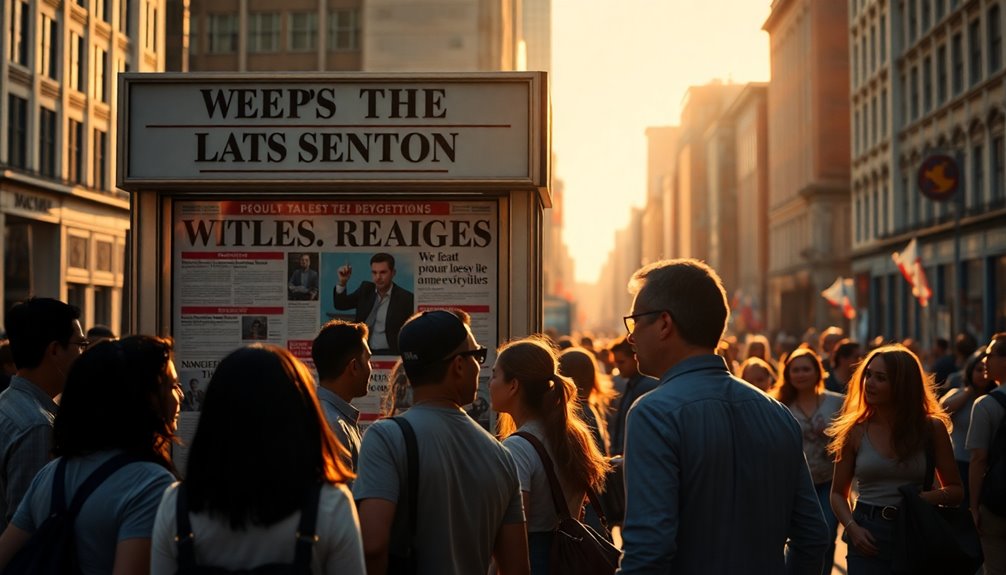
Some countries control their news more than others because of their political systems, particularly authoritarian regimes that prioritize state control over independent media. These governments manipulate information and suppress dissent to shape public perception and maintain authority. Historical contexts and cultural attitudes regarding free speech likewise play significant roles in censorship. Economic factors, like media ownership concentration, further influence the narratives presented. Exploring these dynamics reveals the intricacies behind news control in different societies.
Article Highlights
- Authoritarian regimes prioritize media control to maintain power and suppress dissent, ensuring only government-approved narratives are presented to the public.
- Historical contexts and cultural attitudes towards free speech shape varying levels of censorship across countries, influencing how information is regulated.
- Economic factors, such as media ownership concentration, dictate which voices are amplified, often sidelining marginalized perspectives in favor of profit-driven narratives.
- Religious and ideological influences can promote censorship, with governments enforcing conformity and suppressing dissenting opinions to uphold societal norms.
- Technological advancements enable sophisticated surveillance and censorship tools, complicating efforts to regulate information flow and protect user privacy.
Political Systems and Media Control
Though the relationship between political systems and media control varies considerably across the globe, many authoritarian regimes exert tight grip over news outlets to maintain authority. In these countries, government propaganda dominates, shaping public perception and stifling dissent. By controlling the narrative, these regimes can manipulate information to their advantage, ensuring that only favorable viewpoints are disseminated. Press freedom becomes a casualty in this battle for control, as independent journalism is often suppressed or eradicated entirely. Citizens in such environments crave authentic news that reflects reality, yet face significant barriers to accessing it. The desire for liberation fuels a struggle against these oppressive systems, as people yearn for transparency and the right to express their views without fear of retribution. Moreover, media bias can further entrench these regimes' narratives, as selective coverage elevates certain issues while suppressing dissenting voices.
Historical Contexts of Censorship
Censorship has deep historical roots, shaped by various political, social, and cultural factors. Throughout history, governments have imposed restrictions to control narratives, often citing national security or moral integrity as justifications. These historical precedents illustrate the evolution of censorship, from the suppression of dissent in ancient empires to the modern-day manipulation of information in democratic societies. As societies evolve, so do the methods of censorship, adapting to new technologies and changing cultural environments. This ongoing battle between authority and the public's right to know highlights the importance of comprehending the historical contexts that drive censorship. Recognizing these patterns empowers individuals to challenge oppressive systems and advocate for a freer exchange of ideas, encouraging a more enlightened and liberated society.
Cultural Attitudes Towards Free Speech
Cultural attitudes regarding free speech vary considerably across countries, often influenced by historical contexts of censorship. In some societies, collective rights may take precedence over individual freedoms, shaped by prevailing religious beliefs and ideological frameworks. Comprehending these dynamics is crucial for grasping why certain nations impose stricter controls on their media.
Historical Context of Censorship
As societies evolve, their attitudes toward free speech often reflect deeper historical contexts that shape perceptions of censorship. Comprehending these dynamics requires examining key elements that influence cultural attitudes:
- Censorship Origins: Many countries trace their censorship practices back to authoritarian regimes seeking control over information.
- Historical Legislation: Laws often emerged during pivotal moments, like wars or revolutions, to limit dissent and maintain authority.
- Cultural Narratives: Societal beliefs surrounding authority and individualism can either suppress or encourage open dialogue.
- Technological Advancements: The rise of the internet has challenged traditional censorship, pushing societies to reconsider their stance on free expression.
These factors intertwine, illustrating how historical context continues to shape contemporary views on censorship and free speech.
Collective vs. Individual Rights
While societies often value individual rights, the tension between collective and personal freedoms can greatly influence attitudes toward free speech. In many cultures, the emphasis on collective responsibility can overshadow individual freedoms, leading to restrictions on expression deemed harmful to social harmony. This balance—or imbalance—shapes how citizens perceive their rights. For instance, in some nations, prioritizing community well-being may justify censorship, as authorities argue that free speech can threaten societal stability. Conversely, societies that champion individual freedoms often see free expression as an essential component of democracy. In the end, the struggle between collective interests and personal liberties reflects deeper cultural attitudes, determining how freely ideas can flow and how societies can evolve toward greater openness and liberation. Additionally, the interplay of religion and governance plays a significant role in shaping public perceptions of free speech in various societies.
Influence of Religion and Ideology
Even though many societies prioritize free expression, the influence of religion and ideology can greatly shape their attitudes regarding it. This interplay manifests in several ways:
- Religious Doctrine: Certain faiths promote censorship, viewing dissenting opinions as threats to moral order.
- Ideological Control: Governments may enforce ideologies that suppress free speech to maintain authority and unity.
- Cultural Norms: Societies that value collective beliefs often prioritize conformity over individual expression, limiting discourse.
- Social Consequences: Fear of ostracism or persecution can deter individuals from voicing dissenting views, reinforcing silence.
These factors create environments where religious influence and ideological control stifle the quest for liberation, leaving individuals yearning for a more open dialogue.
The Role of Technology in News Regulation
As technology advances, countries are increasingly using sophisticated censorship tools to control the flow of information. Surveillance and data monitoring have become integral to these efforts, raising concerns about privacy and freedom of expression. Moreover, the rapid evolution of social media presents new challenges for regulators trying to manage content as they balance free speech. The implementation of strong data protection protocols is essential to ensure that individuals' privacy rights are respected amidst these regulatory challenges.
Censorship Technologies Evolving Rapidly
With the rapid advancement of digital technologies, countries are increasingly employing sophisticated censorship tools to control news dissemination. These tools often utilize censorship algorithms and digital surveillance to stifle free expression. Here are four key technologies shaping this environment:
- Content Filtering: Automated systems analyze and block undesirable content before it reaches the public.
- Keyword Monitoring: Governments track specific terms to identify and suppress dissenting opinions.
- Social Media Surveillance: Algorithms scan social platforms for posts that challenge state narratives.
- VPN Blocking: Restrictions on virtual private networks prevent individuals from accessing uncensored information.
Such technologies not just threaten freedom of speech but likewise highlight the urgent need for advocacy and resistance against oppressive regimes. The role of ethical journalism is vital in countering these tactics and promoting a well-informed citizenry.
Surveillance and Data Monitoring
Though many people might think of censorship as a straightforward act of blocking information, surveillance and data monitoring play a crucial role in shaping how news is regulated. Governments utilize various surveillance techniques to track citizens' online activities, influencing the dissemination of news. This constant monitoring raises significant concerns about data privacy, as individuals may hesitate to express dissenting opinions. The erosion of objective truth can further exacerbate the chilling effect of surveillance, as citizens become wary of engaging in public discourse.
| Surveillance Techniques | Impact on News Regulation |
|---|---|
| Social Media Monitoring | Identifies and suppresses dissent |
| Internet Traffic Analysis | Filters access to information |
| Keyword Tracking | Alerts authorities to sensitive topics |
| Device Surveillance | Gathers personal data for profiling |
These tactics not only stifle freedom of expression but furthermore create a culture of fear, undermining the very core of a liberated society.
Social Media Regulation Challenges
Even though technology has the potential to improve communication, it likewise presents significant challenges for regulating social media in the context of news dissemination. These challenges include:
- Social media algorithms often prioritize engagement over accuracy, fueling misinformation spread.
- User privacy concerns complicate the collection of data necessary for effective content moderation.
- Platform accountability is often lacking, leaving users vulnerable to biased or harmful narratives.
- Digital activism can both empower movements and spread false information, creating a double-edged sword.
Navigating these issues requires a delicate balance, as regulators aim to protect freedom while ensuring that information shared isn't misleading. Finding a solution is vital for cultivating a liberated, informed society amid the intricacies of modern communication.
Economic Factors Influencing Media Landscapes
As countries navigate the intricacies of their media environments, economic factors play an integral role in shaping how information is produced and disseminated. Economic inequality often dictates the concentration of media ownership, leading to a few influential entities controlling the narrative. This concentration stifles diverse perspectives, as dominant media outlets prioritize profit over public interest. In societies where wealth is unevenly distributed, marginalized voices struggle to gain visibility, which can perpetuate misinformation and limit access to independent journalism. Moreover, governments may exploit economic vulnerabilities to impose stricter regulations on media, further tightening their grip on information flow. Ultimately, comprehending these economic dynamics is vital for nurturing a more liberated media environment that champions free expression and democracy.
Case Studies: Contrasting Approaches to News Control
As some countries embrace a free press as a cornerstone of democracy, others impose strict controls to shape public perception and maintain authority. These contrasting approaches reveal the complex dynamics of news control:
- North Korea: State-controlled media serves as a tool for news propaganda, ensuring only government-approved narratives reach the public.
- China: Heavy media ownership by the state allows for censorship and manipulation, suppressing dissenting voices.
- United States: A largely free press thrives, yet corporate media ownership can influence reporting, sometimes prioritizing profit over truth.
- Venezuela: Government crackdowns on independent journalism create a climate of fear, stifling freedom and promoting state-sponsored narratives.
These examples illustrate how varying degrees of media control can either nurture or hinder a society's quest for liberation and transparency.
Frequently Asked Questions
How Does International Pressure Affect Media Control in Different Countries?
Like a tightrope walker balancing precariously, countries often feel the strain of international pressure regarding media control. When global standards are emphasized, nations may adjust their policies to align with international norms, using media diplomacy as a tool for credibility. In these instances, the desire for liberation can spark change; oppressive regimes might soften their grip, fearing backlash or isolation. In the end, external influences can reshape the terrain of freedom in media around the world.
What Role Do Journalists Play in Resisting Censorship?
Journalists play an essential role in resisting censorship by upholding journalistic integrity. They endeavor to uncover the truth, often at great personal risk, refusing to let oppressive regimes silence their voices. Through investigative reporting and fearless storytelling, they challenge narratives enforced by those in authority. By nurturing transparency and accountability, journalists enable citizens, igniting a collective desire for liberation. Their commitment to exposing injustice stands as a significant counter to censorship's grip on society.
How Do Citizens Access Uncensored News in Restricted Environments?
In restricted environments, citizens often seek uncensored news through various means. They've turned to VPN usage to bypass government filters, allowing them to access a broader range of information. Social media platforms too serve as essential tools, enabling individuals to share news and connect with like-minded people. By leveraging these resources, citizens can create a network of information that challenges censorship, nurturing a sense of liberation and empowerment in their quest for truth.
Are There Global Organizations That Advocate for Press Freedom?
Coincidentally, as the sun rises, so do organizations like Reporters Without Borders and the Committee to Protect Journalists. They're dedicated to advocating for press freedom worldwide. These global advocates tirelessly work to protect journalists, promote free expression, and challenge oppressive regimes. By raising awareness and mobilizing support, they inspire citizens to demand transparency and liberation in their own countries. Through their efforts, hope for a freer press flickers brighter each day.
How Does Education Influence Public Perceptions of Media Control?
Education markedly shapes public perceptions of media control. When individuals gain media literacy, they become more aware of the information they consume and its sources. This heightened public awareness encourages critical thinking, allowing them to question narratives and identify bias. As a result, educated populations are less susceptible to manipulation and more likely to demand transparency and accountability from their media outlets. In the end, a well-informed citizenry is crucial for advocating for press freedom and resisting oppressive control.